



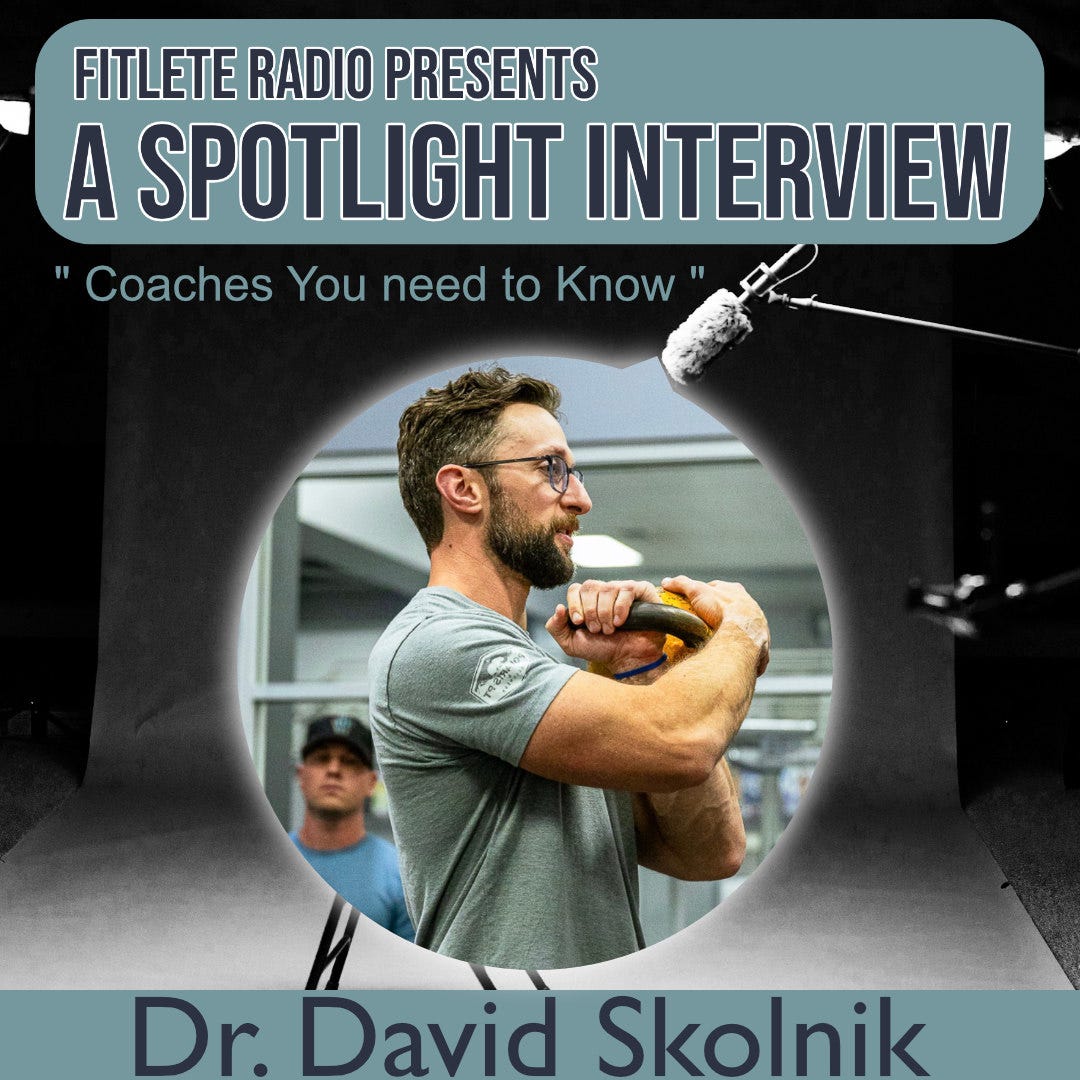
Dr. David Skolnik is a doctor of physical therapy, strength coach, and educator working at the intersection of rehab and performance for adults who have “been through some things” physically. He primarily coaches clients between 40 and 75 years old who show up with real injury histories, chronic pain, and the usual wear-and-tear that makes the average cookie-cutter program a non-starter. Through his company Stronger In Motion, David helps clients move from pain management and medical dependency toward confident, capable strength that shows up in day-to-day life, not just on a spreadsheet.
On the education side, you’ll find David teaching coaches how to think, not just what to cue, so they can better serve the “in-between” clients who are too complex for standard PT discharge but not ready for high-intensity group fitness either. He also hosts the Smarter Strength podcast, where he digs into coaching, critical thinking, and the messy reality of helping humans get stronger, healthier, and more resilient.
All links below are current and active within the last six months or represent David’s evergreen home bases.
Instagram – @dr.davidskolnik.dpt (online coach, educator, and host)
https://www.instagram.com/dr.davidskolnik.dpt/Smarter Strength Podcast:
Stronger In Motion – Coaching & Programs
https://www.strongerinmotion.com/
Key themes and takeaways
Serving the “in-between” client: from pain management to real-life strength
David’s core niche is the client who lives between rehab discharge and traditional personal training: often 40–75 years old, with minor to significant injury histories, lingering pain, and a history of bouncing between PT, injections, and “trying to figure it out.” He describes one client who went from monthly pain-management visits for low back pain to a place where his “bad” days today would have been his best days a year earlier. The win wasn’t just a better MRI; it was being able to carry a 35‑pound grandchild more easily than when that same child weighed 10 pounds.
For David, these are the performance markers that matter: picking up a toddler, traveling without flare-ups, and living life without constantly thinking about pain first. That framing lines up with his broader mission: to use exercise as the vehicle to improve quality of life, not to chase arbitrary performance standards that don’t match the client’s reality.
Strength is king… but the barbell is just a tool
Earlier in his career, especially when he was immersed in powerlifting, David believed the barbell was the non-negotiable centerpiece of effective strength training. Over time, exposure to more diverse clients and contexts led him to rethink that stance; he still sees strength as arguably the most important adaptation to pursue, but no longer elevates any single tool above the rest. He now happily builds strength using dumbbells, kettlebells, machines, cables, and landmine variations, especially when those better suit a client’s history, psychology, or environment.
The key shift is away from tool dogma and toward individual design within solid programming principles: sets, reps, rest, intensity, and progression are non-negotiable, but whether that structure runs through a barbell back squat, a leg press, or a landmine pattern is fully negotiable. For coaches, this is permission to stop forcing square-peg tools into round-hole client needs and instead get obsessed with outcomes and adherence.
Handling “I’ll get a trainer when I’m in better shape”
David takes a refreshingly honest stance: he’s not in the business of convincing people who don’t truly want coaching—he’s in the business of helping people who are ready to change but might need clarity. When someone says they don’t feel ready for a coach yet, instead of pushing harder, he gets curious and asks better questions: What do you want exercise to help you accomplish? What can’t you do now that you’d like to do? What have you already tried, and what were the results?
He uses assessment and education to gently challenge their logic and help them see that “getting in shape first” is usually the very reason they would benefit from having guidance now. His programs are built individually from the ground up, so there is no expectation that a client fit into a pre-written template; instead, the assessment reveals strengths, areas for immediate maintenance, and capacities with the most room for improvement. The goal is for the client to arrive at the conclusion themselves that working with him is the efficient path forward, not to feel sold or pressured.
When clients resist your advice, assume the gap is on you
When a client pushes back on an exercise, training style, or progression, David’s default assumption is not that the client is “difficult”—it’s that something in his communication or planning isn’t aligned with what they want from training. Resistance often signals that the client has either lost the thread between the prescription and their goal or that their goals have quietly shifted without the coach knowing.
His solution is to return to curiosity and clarity: confirm what the client currently wants exercise to do for them, explore whether anything in their life or priorities has changed, and then reconnect the dots between the program decisions and the outcomes they care about. Sometimes that conversation confirms the plan but fixes the understanding; sometimes it reveals that the plan needs to evolve because the target has moved. This approach protects the relationship and keeps training collaborative rather than adversarial.
A “seasonal” model for general population clients
David borrows a seasonal framework from sports performance—pre‑season, in‑season, post‑season, and off‑season and maps it onto general population training. For some clients, their “in‑season” is simply a hypertrophy block; for others, like endurance mountain bikers, it’s literally their racing calendar. The power of this model is that it immediately zooms the lens out from a 4‑week block to a 52‑week training year, which changes how both coach and client react to disruptions.
When you think in months, a one‑week vacation looks like a 25% disruption; when you think in a year, it’s one out of 52, which is emotionally and mathematically much easier to absorb. David also emphasizes layering long-term “buzzword” goals like longevity and the centenarian decathlon into medium and short-term objectives: you don’t train for your 80‑year‑old self directly; you win your 27‑year‑old, 28‑year‑old, 29‑year‑old years, and stack enough of those to build successful decades. For adherence, this is huge: it makes the far-off goal tangible through near-term wins.
Career advice for coaches: deepen your current lane before chasing new ones
When coaches ask, “I’ve taken your course, now what should I study next?”, David zooms out to the business realities of coaching as a career. To stay in the game, a coach has to earn enough from their work not to need a second or third job; that requires being tangibly valuable to the clients they already attract. His advice is to choose continuing education based on the gaps your current clients expose: what questions do they keep asking that you don’t feel fully equipped to answer? What problems do they have that you’re only partially solving?
He warns against “shiny object” CE decisions like advanced kettlebell courses for coaches who mostly work with older adults, or deep dives into running gait mechanics when only two of 22 clients run regularly. Once your business is stable and you’re no longer scrambling for income, then you can afford to layer on niche skills to expand into new avatars. Until then, the fastest way to grow is to become undeniably good at solving increasingly complex problems for the clients you already serve.
Standout quotes from David
You can weave these into the page or use them as pull-quotes in Substack/email.
“Through the magical powers and science of exercise, we’ve given someone a greater quality of life.”
“I no longer feel that the barbell is superior to all other tools or that it has to be incorporated into every single client’s training plan.”
“The thing that determines success for coaching is a combination of ongoing learning and then putting that knowledge into action.”


